NeurIPS 2026 · Sydney, Australia

Logit-Conditioned Diffusion Decoding
for Frozen Discrete-Token VLMs

Improving Visual Fidelity Without Retraining the VLM

1Korea Advanced Institute of Science and Technology (KAIST) 2Microsoft Research Asia (MSRA)
*Work done during an internship at MSRA    †Corresponding authors
KAIST Microsoft
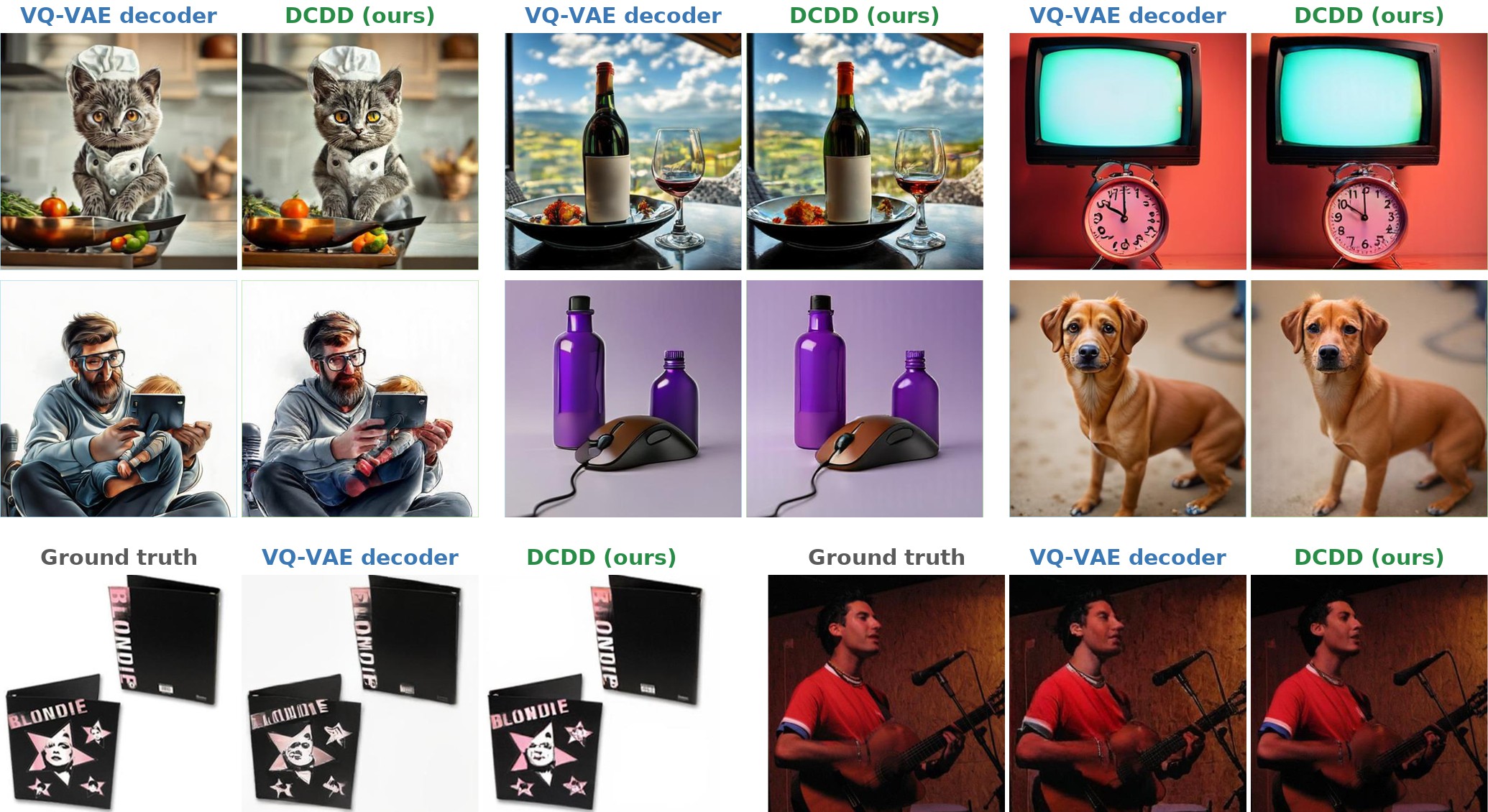
Rows 1–2: Text-to-image generationRow 3: Reconstruction
Text-to-image and reconstruction samples on Janus-Pro 7B: native VQ-VAE decoder versus DCDD on identical tokens

Same VLM output, different decoder. Each pair starts from the same Janus-Pro 7B sampling run (bottom row: the same encoded image). VQ-VAE decoder is the native path, DCDD is ours. The VLM is never retrained.

Overview

Discrete-token vision-language models such as Janus-Pro generate images by predicting sequences of codebook indices and decoding them with a VQ-VAE decoder. This design unifies language and image modeling, but visual fidelity remains limited by the discrete-token decoding stage, often resulting in distorted text, facial artifacts, and blurred textures even when the generated semantics are correct. Prior approaches address this limitation by replacing discrete tokenizers with continuous or hybrid representations, or by integrating diffusion into the generation pipeline. However, these approaches require retraining or realigning the VLM itself.

DCDD (Distribution-Conditioned Diffusion Decoder) takes a different route. Before sampling each image token, the VLM computes a full logit distribution over the codebook, but standard decoding retains only the sampled index, discarding the richer distributional information. These distributions capture the VLM's relative preferences across multiple plausible visual tokens, providing richer information than any single sampled index. We show that this discarded information provides a valuable conditioning signal for a diffusion decoder. At inference, DCDD converts the VLM's pre-sampling logits into distribution-weighted code vectors to condition the diffusion decoder. During training, proxy logits derived from the VQ-VAE encoder are calibrated to approximate the statistical properties of the VLM's logits, eliminating the need for VLM forward passes over the training dataset. The VLM remains frozen, the diffusion decoder is trained solely on ImageNet-1K, and it can optionally replace the native VQ-VAE decoder without modifying the VLM. On Janus-Pro 7B, DCDD reduces reconstruction FID by 74% and MJHQ-30K generation FID by 34%, while preserving performance on GenEval, DPG-Bench, and WISE.

Image quality (fidelity) · lower is better
−74%rFID, ImageNet-1K
−34%gFID, MJHQ-30K
Semantics of VLM · kept, as intended
+1.1GenEval, same semantics
0VLM parameters changed


Motivation

Where the detail is lost, and what the VLM knows that standard decoding throws away.

The standard text-to-image path of a discrete-token VLM. DCDD replaces only the last step.

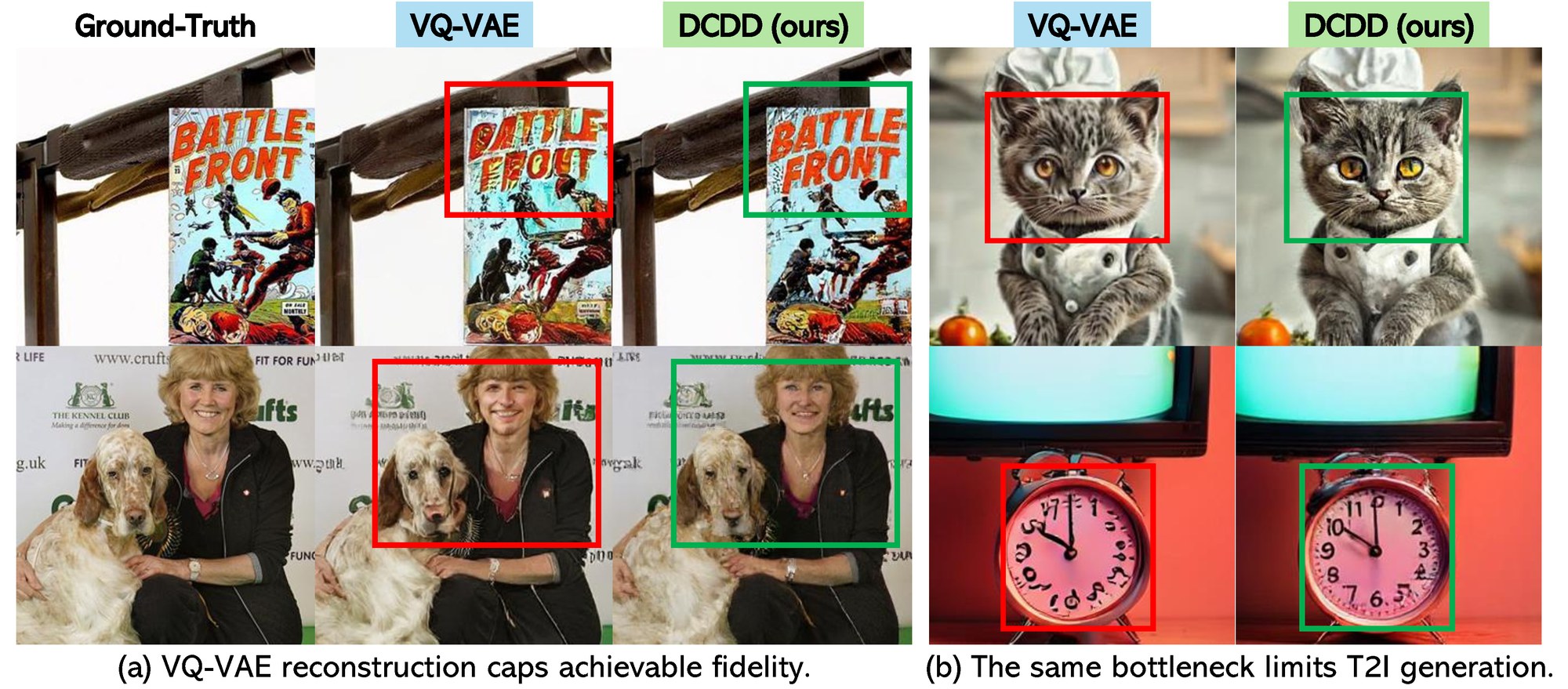
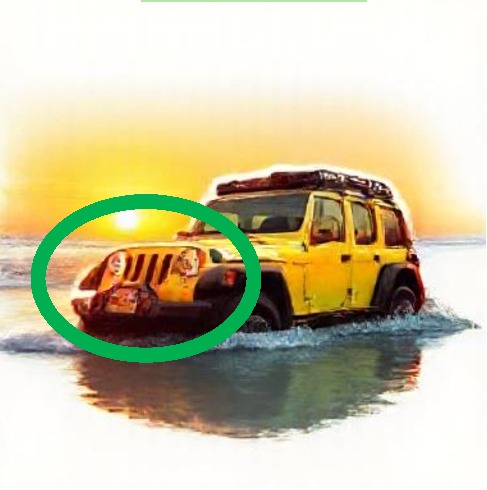
The VQ-VAE decoder is the fidelity bottleneck: reconstruction and text-to-image examples
The VQ-VAE decoder caps fidelity. (a) Even with no VLM involved, the VQ-VAE alone loses detail on a real image: text and facial features degrade. (b) Images generated by the VLM pass through the same decoder and lose the same detail. DCDD addresses this without modifying the VLM.
1

Detail is lost in the token-to-pixel step

Encoding a real image into discrete tokens and decoding it back, without the VLM, already loses text, faces, and textures. The bottleneck is the decoder, not the VLM, so the decoder is where fidelity can be recovered without retraining.

Bottleneck: the VQ-VAE decoder
2

The VLM outputs a distribution; decoding keeps one entry

Before sampling each image token, the VLM produces a probability distribution over all codebook entries. Standard decoding keeps a single entry and discards the rest.

The most likely code holds only 22% of the probability mass; one-code decoding discards the remaining 78%
3

Condition the decoder on the full distribution

DCDD conditions a diffusion decoder on a probability-weighted combination of codebook vectors plus per-token uncertainty features, not on one code. Only the decoder changes; the VLM remains unchanged.

No change to the VLM or its tokenizer

Method

Only the diffusion decoder is trained. Each of the three components answers one practical question.

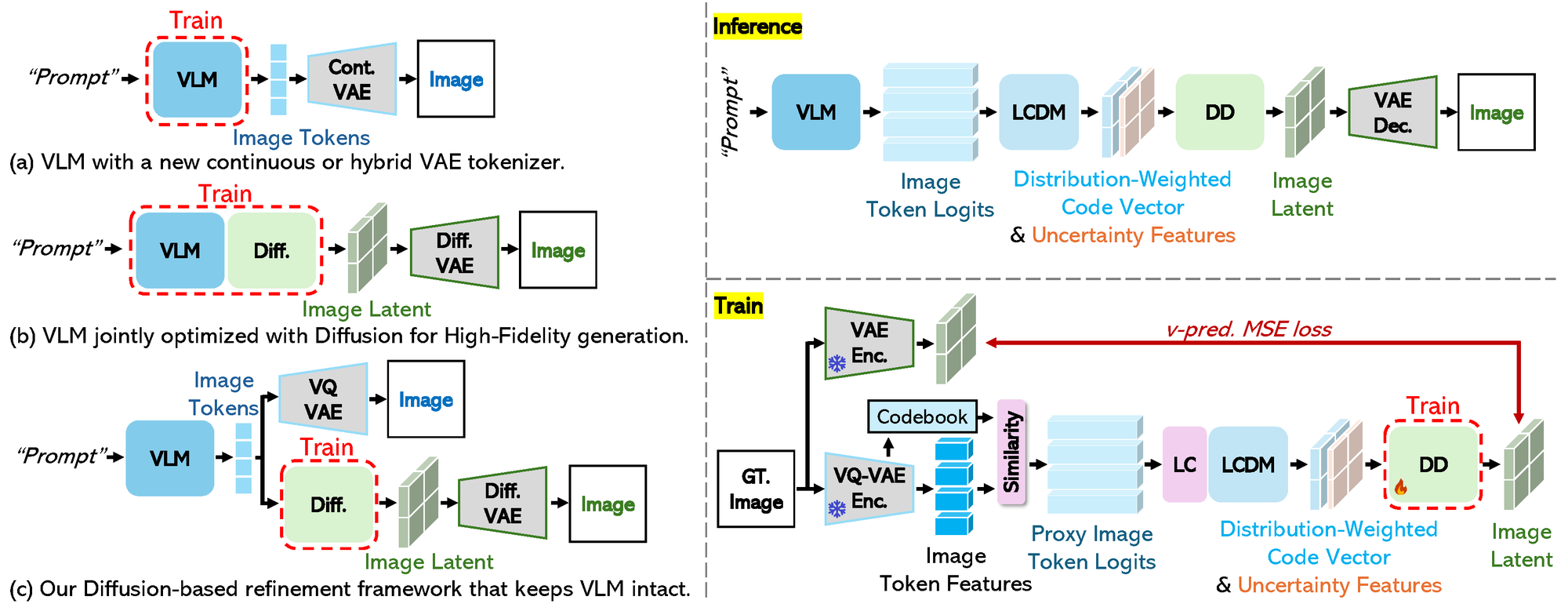
DCDD overview: comparison of strategies and the inference/training pipelines
Left: prior routes to higher fidelity (a, b) retrain the VLM; DCDD (c) trains only the decoder. Right: at inference the VLM's logits become the decoder's conditioning. At training, encoder proxy logits are first calibrated to look like the VLM's.
Training: ImageNet-1K only, 50K stepsInference: swap the VQ-VAE decoder for DCDD; the VLM is unchanged
LCDMLogit-to-Code Distributional Mapping

How do logits become a conditioning signal?

Decode from a weighted sum of code vectors, not one code. A softmax over the codebook turns each token's logits into a probability-weighted mixture of codebook embeddings. Per-token uncertainty features (entropy, confidence, margin, top-K mass) preserve how peaked or spread the distribution is.

LCLogit Calibration

How do we train without running the VLM on every image?

Train without the VLM. Training uses proxy logits from the VQ-VAE encoder, which are far flatter than the VLM's. A gradient-free calibration aligns their distributional statistics with those of the VLM's logits, reducing the conditioning mismatch between training and inference.

Why it matters. Logit calibration enables decoder training using only VQ-VAE encoder outputs, without running the frozen VLM over the training dataset.

DDDiffusion Decoder

What renders the final image?

FLUX.1-Fill, fine-tuned on these features. The decoder renders the image from the code vectors and uncertainty maps. It receives no text prompt, only the VLM-derived token distributions, so it sharpens the image while preserving the VLM's intended semantics.

What each component adds

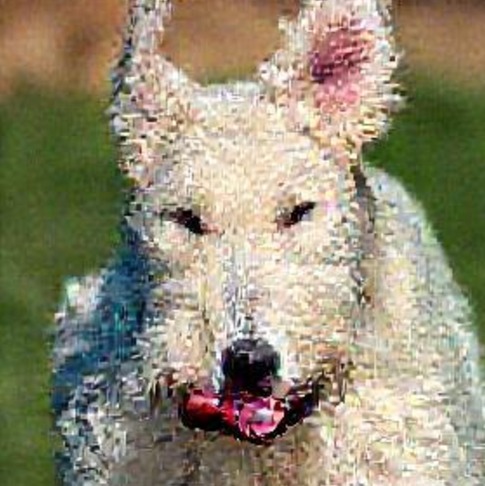
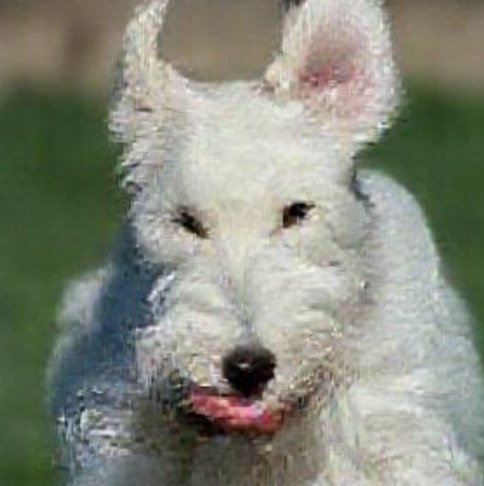
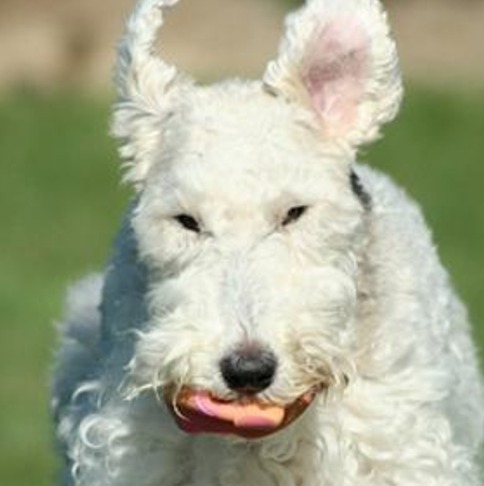
ImageNet-1K reconstruction with decoders trained for 10K steps. Same image, same encoder outputs; only the conditioning pipeline differs.

Diffusion decoder conditioned on one code per token
Diffusion decoder onlyOne code per token: noisy, broken textures.
DCDD without logit calibration
+ LCDM, without LCStructure returns; contrast and color noise remain.
Full DCDD
Full DCDDStable color tones, noise suppressed.
Ground truth
Ground truthReference image.

Results

Janus-Pro 7B, 384×384, decoder trained 50K steps on ImageNet-1K. Fidelity improves sharply; semantic scores stay where they were or edge up.

MetricVQ-VAE decoderDCDDChange
Reconstruction fidelity
rFID, ImageNet-1K ↓2.850.75−74%
rFID, MJHQ-30K ↓4.491.81−60%
Generation fidelity
gFID, MJHQ-30K ↓14.299.42−34%
Semantic alignment
GenEval ↑77.2478.31+1.07
DPG-Bench ↑86.9487.64+0.70
WISE consistency ↑1.2781.320+0.042

Cross-domain generalization. The decoder is trained on ImageNet-1K only and never sees MJHQ-30K, so the MJHQ rows measure transfer to a different image distribution. Semantic benchmarks (GenEval, DPG-Bench, WISE) are preserved rather than traded for fidelity.

Computational overhead. At 30 denoising steps, DCDD adds 31% end-to-end latency (11.9 s → 15.6 s per image on an A100) in exchange for the 34% gFID reduction above. With 10 steps the overhead drops to about 11% while reconstruction still outperforms the native decoder on every metric. In both settings the frozen VLM accounts for most of the inference time.

Transferability across VLM scales. The diffusion decoder trained for Janus-Pro 7B can be reused with Janus-Pro 1B, which shares the same tokenizer and exhibits similarly structured token distributions, without additional decoder training (MJHQ-30K Animals gFID 35.14 → 26.09).

Why does DCDD work?

Janus-Pro 7B, MJHQ-30K gFID ↓. The improvement comes not only from diffusion-based decoding, but also from preserving the VLM's distributional information.

1. Is the gain from the diffusion prior, or from the logit distribution?

Same decoder and data; only the conditioning changes: one sampled token vs. full logits.

Full logits give a further 15% gFID reduction beyond the diffusion prior alone.

MJHQ-30K generation FID (lower is better). The two diffusion variants share the same decoder, initialization, training data, and schedule; only the conditioning differs. Conditioning on the full distribution improves generation fidelity beyond what diffusion-based decoding alone achieves: a further 15% reduction in gFID and 36% in ImageNet-1K rFID relative to the decoder conditioned on a single sampled token.

2. How much of the distribution is needed?

Condition on only each token’s top-k logits.

Even top-2 recovers 76% of the full-distribution gain; the full distribution is best. gFID ↓, MJHQ-30K Animals

Using only the top-2 codebook entries recovers 76% of the improvement from sampled-token to full-distribution conditioning, consistent with our Otsu-based analysis showing that capable VLMs assign meaningful probability to multiple tokens.

3. Better than image-to-image refinement

MJHQ-30KgFID ↓CLIP-I ↑
FLUX.1-Kontext, generic prompt10.670.875
FLUX.1-Kontext + own prompt10.980.853
DCDD9.420.909

Refiners drift from the VLM’s intent; DCDD keeps it.

Compared with image-space refinement using FLUX.1-Kontext on the VQ-VAE output, DCDD achieves lower gFID (9.42 vs. 10.67) and higher CLIP-I consistency with the VLM's intended content (0.909 vs. 0.875).

Interactive Comparison

Drag the slider: VQ-VAE decoder on the left, DCDD on the right, decoded from the same VLM outputs. Reconstruction samples also show the ground truth, and the side-by-side view places all images next to each other.

View
Text-to-image
Reconstruction
VQ-VAE decoder DCDD (ours)

Samples from the paper (Janus-Pro 7B, 384×384). More results, ablations, and limitations are in the paper.

BibTeX

@inproceedings{hong2026dcdd,
  title     = {Logit-Conditioned Diffusion Decoding for Frozen Discrete-Token {VLMs}},
  author    = {Hong, Ji Woo and Koo, Gwanhyeong and Yoon, Hee Suk and Yoon, Eunseop and Eom, SooHwan and Dai, Qi and Luo, Chong and Yoo, Chang D.},
  booktitle = {Advances in Neural Information Processing Systems (NeurIPS)},
  year      = {2026}
}

Acknowledgements

This research was supported by the MSIT (Ministry of Science, ICT), Korea, under the Global Research Support Program in the Digital Field program (RS-2024-00436680) supervised by the IITP (Institute for Information & Communications Technology Planning & Evaluation). This project is supported by Microsoft Research Asia.

DCDD builds on Janus, FLUX.1-Fill-dev, and Diffusers. We thank the authors for releasing their models and code.